
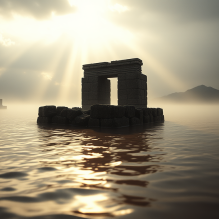
While listening to a “Bible in a Year” podcast, I noticed something new. The first stage of Noah’s Flood was the swelling of groundwater. The rain came later. I recognized that strange pattern.
This parallels the meltwater floods and eventual rainfall caused by glacial melting during the Younger Dryas Period, around 10,000 BC. This period saw an actual global flood. Interestingly, the world’s oldest known city, Göbekli Tepe, was built shortly after this flood. It is in the region of Turkey where Noah is said to have landed.
Literal interpretations of Noah’s flood place it around 2200 BC. This doesn’t align with the time of the Younger Dryas Flood.
The biblical timeline for 4000-2000 BC was constructed by adding up the ages in the “son of” genealogies. This method assumes the list contained no gaps.
Perhaps the list includes only key figures in places. We use it as a strict chronology, but the age of the universe may not be there to extract.
In the New Testament, Jesus is called the “Son of David” and the “Son of Abraham”. We know from context that “Son of” means “descendant of”, because these men lived thousands of years apart.
I view the pre-flood stories as real events highly layered in metaphor. From Abraham onward, the Bible reads like a historical narrative with miraculous elements.
I see no conflict between an old Earth and an inerrant Bible.
In my view, the Younger Dryas flood was the real Noah’s Flood.
Leave a Reply